Poke Derby stats
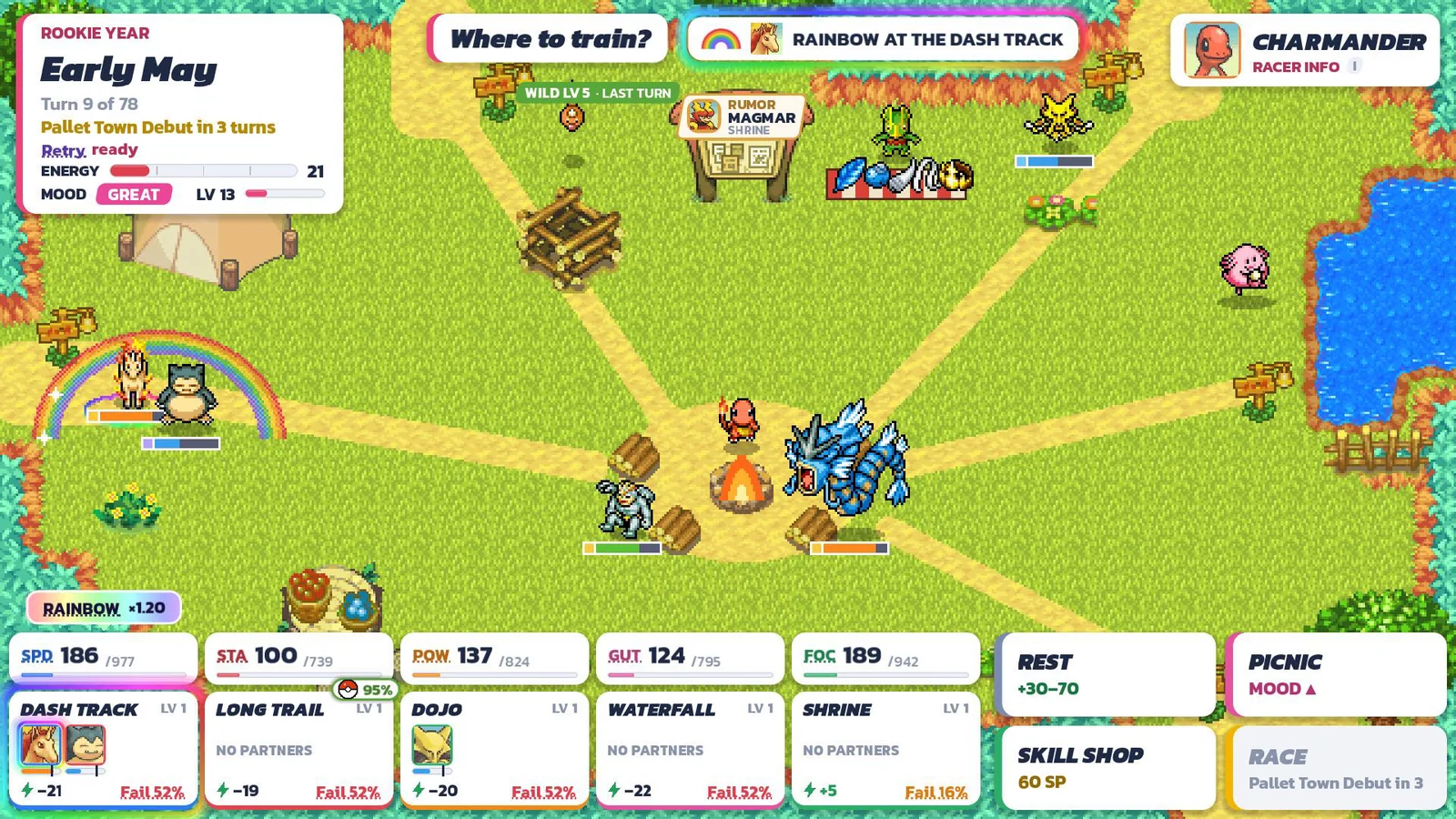
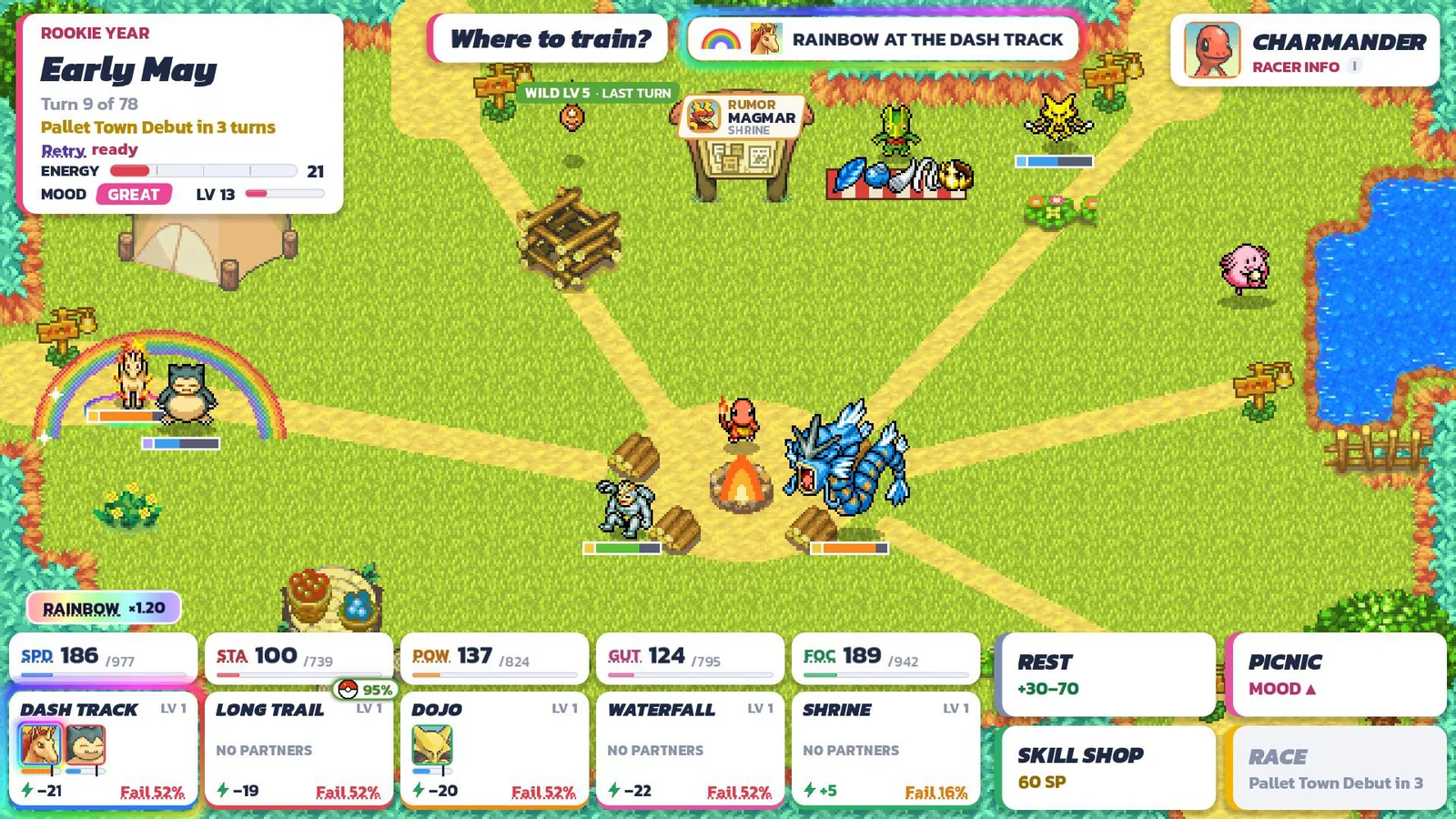
Five stats, five facilities, one energy bar. The definitions below summarize the official guidebook, while energy costs come from the version 1.7.0 career file.
The five stats
| Stat | Guidebook summary | Facility | Where it shows up |
|---|---|---|---|
| Speed | Determines pace, with doubled weighting late in the race. | Dash Track | Late race |
| Stamina | Energy for racing; the remaining reserve feeds the late spurt. | Long Trail | Spurt |
| Power | Helps acceleration, climbing and movement through traffic. | Dojo | Start, climbs, traffic |
| Guts | Strengthens the final spurt and finish-line duels. | Waterfall | Final spurt and duels |
| Focus | Supports move readiness, composure and efficient lines. | Shrine | Skills, calm, line, bends |
Energy and mood
| Action | Change | Note |
|---|---|---|
| Train | −19 to −22 at level 1; −25 to −28 at level 5 | Also gives skill points. Failure gives nothing and drops mood one step. |
| Rest | +30 / +50 / +70 | The recovery option when the bar is low. |
| Picnic | +10 energy, mood up | Mood steps are 80, 90, 100, 110, 120 percent. |
| Shrine | +5 energy | The Focus facility does not spend energy. |
| Failed train | No gain | Five points come off that facility’s stat and mood drops one step. |
Energy tops out at 100. A good mood makes training pay more and the race a little faster. The guidebook does not print the exact race coefficient, so I am not going to invent one. Low energy raises the chance a training fails. The base file defines failure slope 180 and cap 95, with failStart 50 for four facilities and 30 for the Shrine; these are base tuning values rather than a prediction after all modifiers.
Race zones
| Zone | What the stat is doing |
|---|---|
| Gate | Power helps the launch. |
| Early | Position and traffic. Power is the traffic stat. |
| Mid | The long middle. Stamina is the tank you are spending. |
| Late | Speed counts double here. |
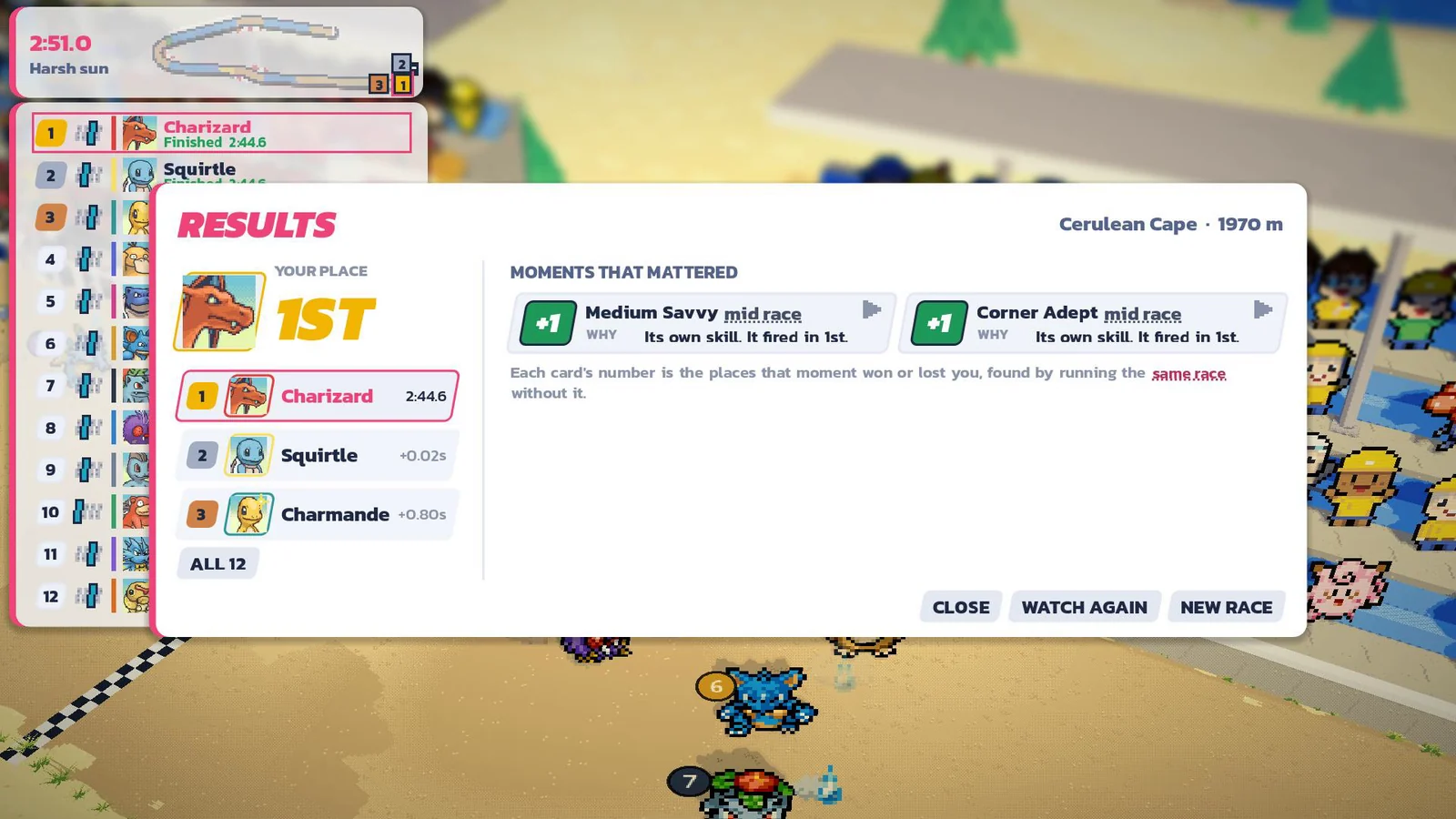
| Final straight | Guts decides the last spurt and line duels. Focus keeps the line tidy. |
Caps, stars, partners
The species sets the ceiling. Each star adds 10 to the starting stats and 5% to the cap. Evolution raises the cap. Training, events, and gear can still add on top. Those are base rules from the data, not a finished build’s screenshot.
Each partner sits on one facility for a training. Carry-over bond level maxes at 10. During a career, the separate bond gauge runs from 0 to 100; bond training requires at least 80 and the partner’s own facility. Rainbow is two partners on the same facility multiplying each other. The screenshot of Nidoran♂ shows base 75/75 becoming Training +8.3% and Bond +24.8% at bond 7/9, so I do not print a base of 105 as “105%”. Pikachu is the only card flagged bondShare: other partners gain more bond when they train with it.
What to train first
- Sprint grades care about Speed. Dash Track is the facility, and late-race double Speed is why.
- Long grades care about Stamina. Long Trail fills the tank the spurt spends.
- If energy is already low, the Shrine is the training that gives 5 back. Rest is still the big refill.
Questions
What does Focus do in Poke Derby?
Focus supports move readiness, composure and efficient racing lines. The Shrine trains it and gives 5 energy.
What is fatigue in Poke Derby?
The public rules talk about energy, not a separate fatigue bar. Level-1 training spends 19 to 22 energy outside the Shrine; higher facility levels cost more. Rest and picnic restore it.
Do stats cap?
Yes, by species. Stars add 10 starting points and 5% to the cap. Evolution raises the cap. A single “enough” number is not published.
Keep reading
Sources
- In-game guidebook — checked 12 Nov 2026
- Career screenshot — checked 12 Nov 2026
- Remakit — checked 12 Nov 2026